
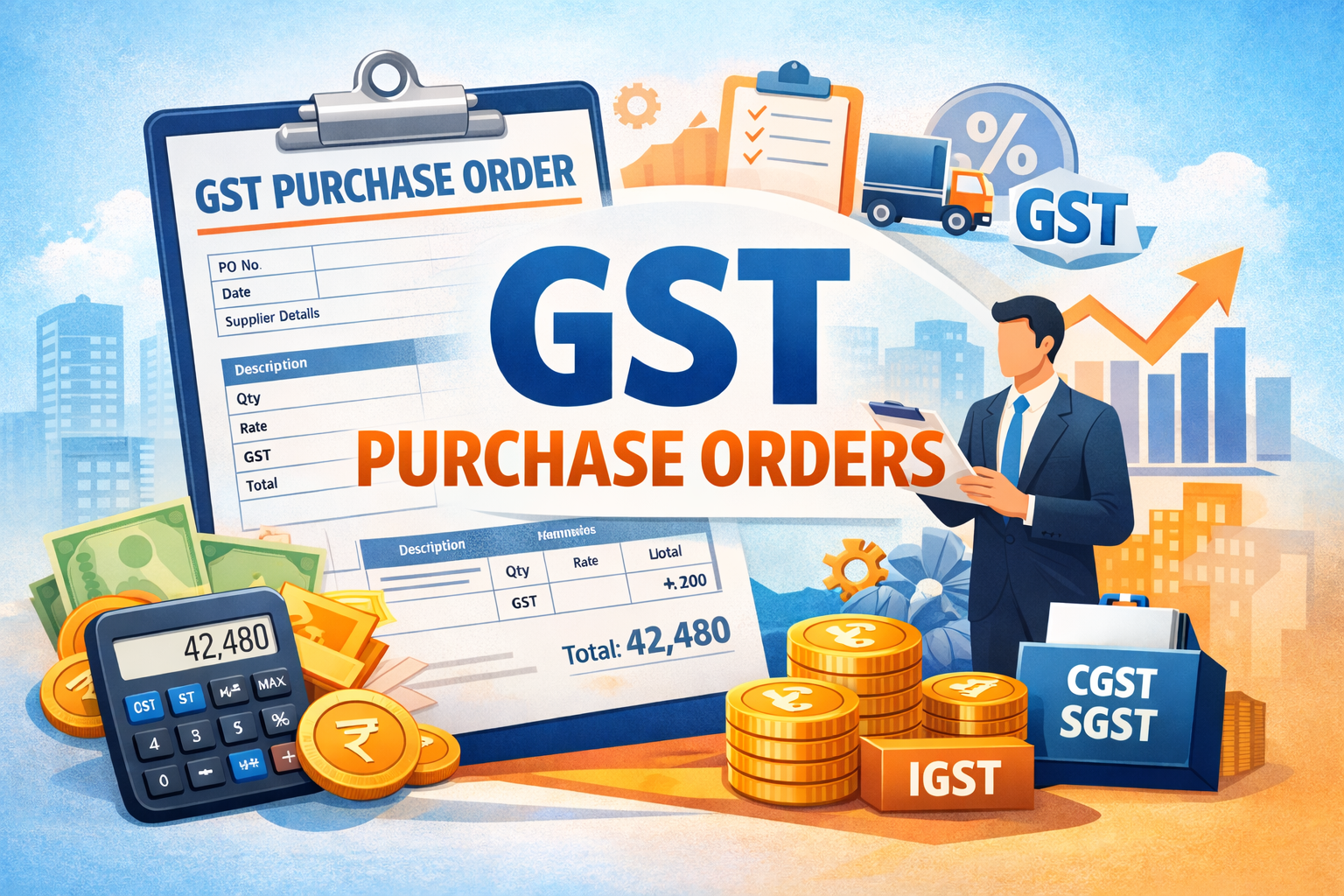
In a GST-registered business environment, documentation plays a crucial role in maintaining transparency, compliance, and smooth operations. One of the most important procurement documents is the GST Purchase Order (PO). Whether you are running a trading company, manufacturing unit, or service-based firm, understanding how GST purchase orders work is essential for proper tax compliance and inventory control.
This article explains what a GST purchase order is, its format, key components, and why it is important for businesses operating under the GST regime.
What is a GST Purchase Order?
A GST Purchase Order is an official document issued by a buyer to a supplier to confirm the intention to purchase goods or services, including applicable GST details. It outlines the quantity, agreed price, tax rate, delivery terms, and payment conditions.
Unlike a GST invoice, a purchase order does not create a tax liability. Instead, it acts as a legally recognized commercial document that authorizes the supplier to deliver goods or services as per agreed terms.
Once the supplier delivers the goods and issues a GST invoice, the purchase order serves as a reference document for verification and accounting.
Why is a GST Purchase Order Important?
A GST purchase order is not just a formality. It plays a critical role in business operations:
1. Ensures Clear Communication
It clearly specifies product details, GST rates, and agreed pricing, reducing disputes between buyer and supplier.
2. Helps in GST Compliance
Mentioning GSTIN of both parties ensures that transactions are properly recorded for Input Tax Credit (ITC) claims.
3. Controls Business Spending
Purchase orders require approval before procurement, helping companies manage budgets effectively.
4. Supports Inventory Management
A PO helps track incoming goods and ensures that deliveries match the ordered quantities.
5. Simplifies Audit and Accounting
During audits or GST assessments, purchase orders provide documented proof of procurement intentions.
Key Components of a GST Purchase Order
A professionally prepared GST purchase order should include the following details:
1. Buyer Details
- Business name
- Address
- Contact details
- GSTIN
2. Supplier Details
- Supplier name
- Address
- GSTIN
- Contact details
3. Purchase Order Information
- Purchase Order Number (unique reference)
- Date of issue
- Delivery date
- Place of supply
4. Description of Goods/Services
- Product or service name
- HSN (Harmonized System of Nomenclature) code (for goods)
- SAC (Service Accounting Code) (for services)
- Quantity
- Unit price
- Total amount before GST
5. GST Details
- Applicable GST rate (5%, 12%, 18%, 28%, etc.)
- CGST & SGST (for intra-state transactions)
- IGST (for inter-state transactions)
- Total GST amount
6. Total Order Value
- Subtotal (before tax)
- GST amount
- Grand total (including GST)
7. Terms and Conditions
- Payment terms (e.g., 30 days credit)
- Delivery terms
- Warranty details
- Cancellation policy
Example Format of a GST Purchase Order
ABC Enterprises
Chennai, Tamil Nadu
GSTIN: 33ABCDE1234F1Z5
Purchase Order No: PO-2026-045
Date: 22-02-2026
Supplier:
XYZ Suppliers
GSTIN: 33XYZAB5678K1Z9
| Description | Qty | Unit Price | Amount |
|---|---|---|---|
| Office Desks | 20 | ₹5,000 | ₹1,00,000 |
Subtotal: ₹1,00,000
CGST (9%): ₹9,000
SGST (9%): ₹9,000
Total GST: ₹18,000
Grand Total: ₹1,18,000
Payment Terms: 30 days from invoice date
Delivery: Within 10 working days
GST Purchase Order vs GST Invoice
Many businesses confuse purchase orders with invoices. However, their purposes are different:
| Purchase Order | GST Invoice |
|---|---|
| Issued by buyer | Issued by supplier |
| Before supply of goods/services | After supply |
| No tax liability | Creates tax liability |
| Internal control document | Legal tax document |
A purchase order acts as an authorization, while an invoice confirms the transaction and is used for GST filing and Input Tax Credit claims.
Best Practices for Creating GST Purchase Orders
- Use Accounting Software
Automated systems reduce errors in GST calculation and documentation. - Verify Supplier GSTIN
Always confirm supplier GST registration status before placing an order. - Mention Place of Supply Clearly
This determines whether CGST/SGST or IGST applies. - Maintain Sequential Numbering
Use unique PO numbers for proper tracking and auditing. - Cross-Check GST Rates
Ensure correct tax rates are applied to avoid future disputes or penalties.
Conclusion
A GST purchase order is a vital business document that ensures clarity, accountability, and tax compliance. It formalizes procurement, supports budgeting and inventory control, and serves as a reference for GST invoices and audits.
By properly structuring GST purchase orders with accurate GST details, businesses can streamline operations, reduce errors, and maintain smooth relationships with suppliers. In today’s GST-regulated environment, mastering purchase order documentation is not optional—it is essential for efficient and compliant business management.
